

News
Mobrilz
February 25, 2026
7:30 AM
SEO used to be a volume game. You’d churn out three posts a week, toss in some keywords, and wait for the traffic. In 2026, that playbook is dead. Today, Google is looking for a smooth ride, not just a full library. If your site feels clunky or slow, you're trying to win a Formula 1 race with flat tires. It doesn't matter how fast your engine (content) is if your tires (performance) can't grip the road.
We’re seeing that user patience has hit an all-time low. Research shows that as mobile load time climbs from 1 to 10 seconds, the probability of a visitor bouncing increases by a massive 123%. If you aren't paying attention to Core Web Vitals, you aren't just losing rank—you're literally handing your customers to the competition.
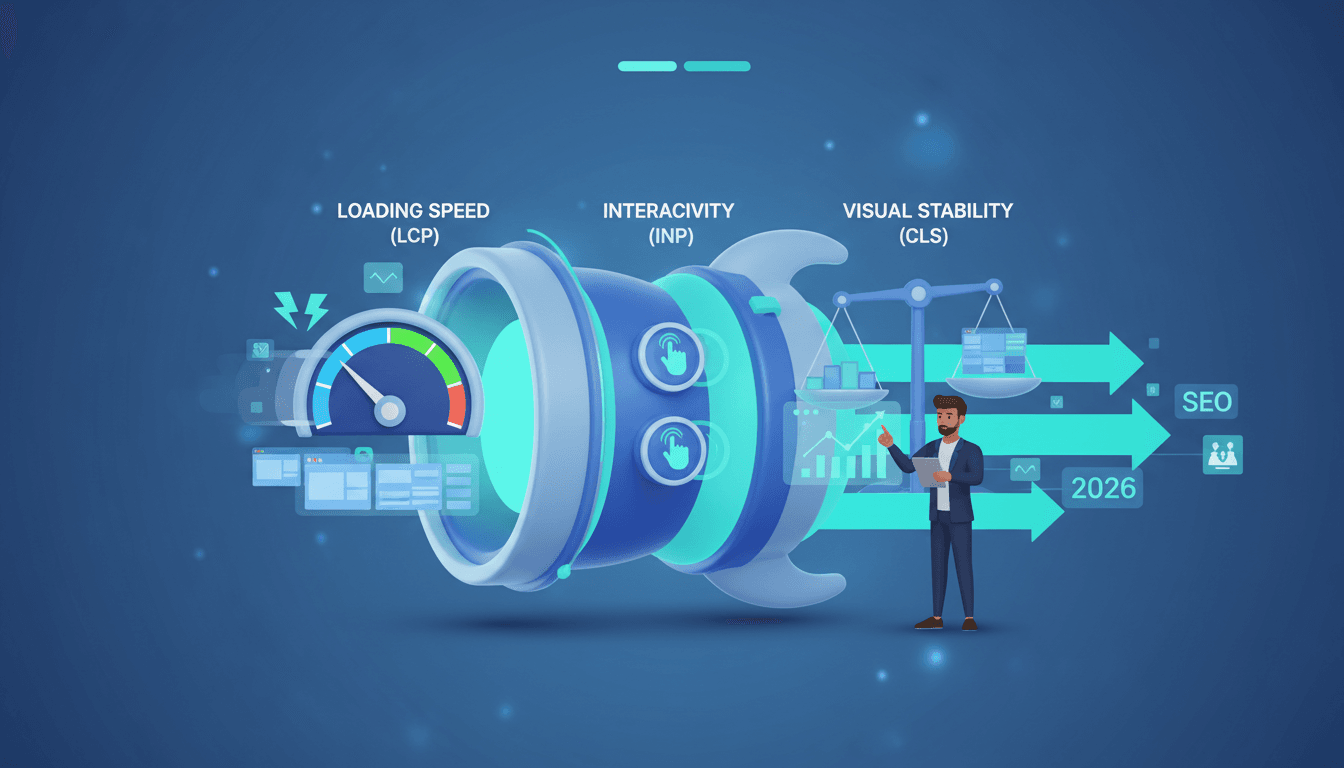
Think of Core Web Vitals as a digital report card. Google uses three specific "grades" to decide if your website is a joy to visit or a total headache:
Loading Speed (LCP): This measures how long it takes for the main part of your page to show up. If it takes more than 2.5 seconds, people start reaching for the "back" button.
Responsiveness (FID/INP): Have you ever clicked a button and... nothing happened? That delay is what this measures. In 2026, Google focuses on how quickly the site reacts to every single tap.
Visual Stability (CLS): This tracks whether things "jump around" as the page loads. There’s nothing more annoying than trying to click a link, only for an image to pop in and move the link down, making you click an ad instead.
In short, Google wants your site to be fast, responsive, and stable. Why? Because that’s what a good user experience looks like. Smart web design ensures these elements are balanced from the very start of a project.
Google’s entire mission is to give people the best possible results. If they recommend a site that is slow or glitchy, Google looks bad. That’s why these factors are now a huge part of quality SEO services.
But it’s not just about pleasing an algorithm; it’s about your customers:
Patience is at an all-time low: As mentioned, if your loading time is high, you’re essentially closing the door on potential leads before they even see your offer.
First Impressions Count: A fast, mobile friendly site feels professional. A slow, clunky one feels like a business that doesn't care about the details.
Better Conversions: When a site is snappy and uses a clean, responsive design, people are much more likely to actually buy something or fill out a contact form.
Improving these scores usually comes down to high-quality Web Development and a focus on performance. You don't need to do the heavy lifting yourself, but it helps to know what to ask for.
Shrink Your Images: Huge photos are the #1 reason for a slow site speed. This is a basic rule of modern web design—compressing images so they look great but load instantly.
Clean Up the "Under the Hood" Stuff: Over time, websites collect "digital dust"—extra code that slows things down. Efficient Web Development clears this out to keep your page performance high.
A great responsive design is more than just making things 'fit' on a phone. It’s about ensuring the site responds instantly to a thumb tap. In 2026, Google replaced the old FID metric with Interaction to Next Paint (INP). This measures the full delay until a user sees a visual change after they click. On mobile, 'Good' INP scores are only hit about 67% of the time. If your site is in the other 33%, you're invisible to a huge chunk of your market.
When you hire professional SEO services, they shouldn't just be handing you a list of keywords. They should be looking at your site like a mechanic looks at a car. If the technical 'engine' isn't tuned, even the best content in the world won't rank high because Google won't risk sending users to a frustrating experience.
Bottom line: A slow site is a growth killer. By 2026, Core Web Vitals have become the baseline, not a 'nice-to-have.' They dictate where you show up in the search results and, more importantly, whether people actually stick around to buy.
If your site feels even a little sluggish, don't ignore it. Improving your load times by just 0.1 seconds has been shown to boost retail conversion rates by 8%. That’s the difference between a visitor and a customer. Stop guessing and start optimizing.
News
Blog
Blog
Blog
Visit Us
E-160, 3rd Floor, Sector 63 Noida, U.P. 201301, India
Monday - Friday: 9:00 AM - 6:00 PM (IST)
Please schedule an appointment before visiting
Services
© 2026 Mobrilz. All rights reserved.
Made with❤️in India